What Affects Tree Removal Cost in New Jersey
Every tree is different, and so is every removal. The factors below determine the scope of the job. For an accurate estimate on your specific tree, call (973) 343-6868. Every estimate is free.
"How much will it cost to take down my tree?" is the number one question we hear. The honest answer is that every tree is unique, and tree removal cost in New Jersey covers a wide range because every job is different. Tree removal pricing for a small ornamental in an open yard is a completely different scope than a 75 foot oak overhanging a two story house. This page explains the real factors that determine the scope of a tree removal and gives you a broad orientation range so you can understand what goes into your tree removal estimate before we arrive. We are a licensed NJ tree removal company serving 11 counties across North and Central New Jersey.
Any prices referenced on this site are general estimates. Your actual price may be higher or lower depending on the tree's size, species, condition, location on the property, and equipment needed. The only way to get an accurate number is a free on-site estimate.
Broad Cost Orientation Ranges in New Jersey
Most homeowners want at least a rough idea of where tree removal pricing tends to land before we come out. Below are broad orientation ranges only. They are not quotes, and they are not fixed brackets. Your actual price depends on the factors covered further down this page.
- Tree removal in New Jersey commonly falls in a broad $300 to $5,000+ range.
- Stump grinding as an add-on commonly falls in a broad $100 to $400 range.
These ranges exist to set expectations, not to set a price. A small ornamental in an open yard sits near the low end. A large mature tree with crane work, tight access, or storm damage sits much higher. The only way to know your number is a free on-site estimate where we can see the tree, the surroundings, and the access.
Tree Size: Height, Trunk Diameter, and Canopy Spread
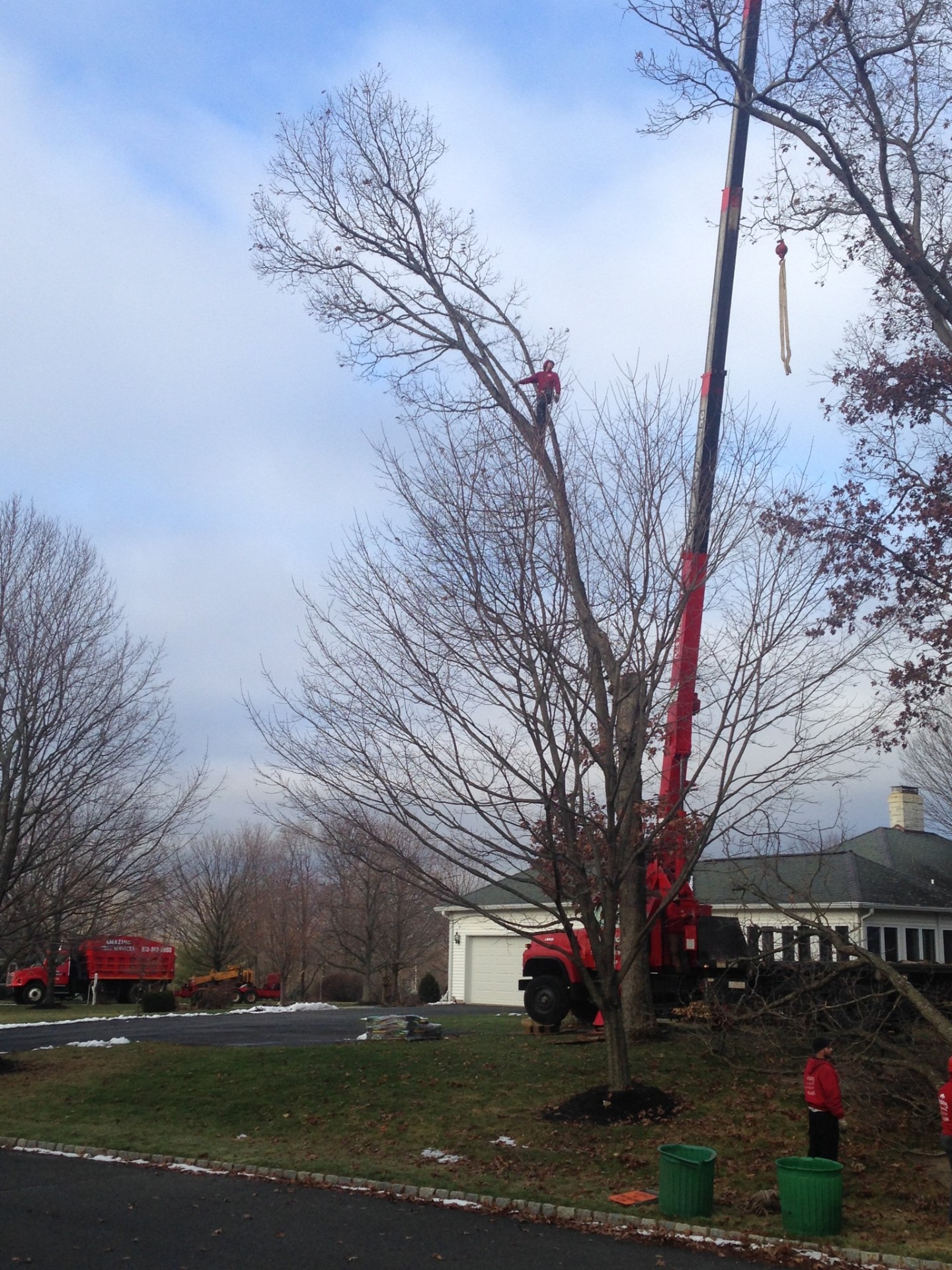
The height and width of the tree are the biggest factors. Taller trees require more equipment, more time, and more crew. Wider canopies mean more material to cut, lower, and haul away.
Small trees under 25 feet tall are the most straightforward removals. These include young maples, ornamental trees, and smaller species that have not had decades to grow.
Medium trees between 25 and 50 feet cover a wide range of common residential trees. This is where most of the removals we do in North NJ fall. The complexity increases significantly when a medium tree is squeezed between a house and a fence line because of the rigging and precision required.
Large trees over 50 feet are the most complex jobs. These are mature oaks, tall pines, and old growth hardwoods that have been on the property for decades. The equipment involved often includes a crane, and the crew needs to section the tree from the top down with careful rigging.
How Tree Species Affects the Job
Different species have different wood density, branch patterns, root systems, and growth habits. All of that affects how long the removal takes and what equipment is needed.
Oak trees are among the most demanding to remove because of their size, weight, and wide branching structure. A mature oak can weigh several tons and the dense, hard wood means slower cuts and heavier sections to rig down.
Maple trees vary widely in size. A small ornamental maple is a quick job. A 50 foot sugar maple with a broad canopy over a roofline is a different story entirely.
Pine trees can grow very tall but their wood is softer and lighter than hardwoods. The challenge with pines is height and sap. Tall pines still require cranes or extensive rigging.
Ash trees have become a growing concern across New Jersey because of the emerald ash borer. Dead ash trees are brittle and unpredictable, which adds risk and time to the removal.
Birch, poplar, dogwood, and spruce and fir trees each bring their own characteristics that affect the scope of the job.
Tree Condition: Living, Dead, or Storm Damaged
A tree's condition changes the difficulty and risk of the removal.
Healthy living trees are the most straightforward to remove. The wood is solid, the branch structure is predictable, and the crew can plan every cut with confidence.
Dead trees are unpredictable. Dead wood is brittle and can snap without warning. A dead tree that looks like it is standing solid might have a hollow trunk or a root system that has already failed. The added risk can increase the complexity of the job.
Fallen trees are often simpler because the tree is already on the ground. The crew sections it and hauls it away. But if the tree fell on a structure, a fence, or power lines, the removal becomes more complex.
Storm damaged trees require careful assessment because the remaining structure may be under stress. Cutting a stressed tree incorrectly can cause it to split or fall in an uncontrolled direction.
Location, Access, and Additional Factors
Location on your property matters. A tree in the middle of an open yard with truck access on all sides is the simplest scenario. A tree wedged between your house and your neighbor's fence with power lines overhead is the most complex. Tight access adds rigging time and may require a crane.
Stump removal is usually a separate consideration. After the tree comes down, the stump stays behind unless you have it ground out. If you are having a tree removed and want the stump gone too, ask us to bundle it — it is more efficient when done on the same visit.
Permit requirements can vary by municipality in New Jersey, and we confirm any local requirements with you during the on-site estimate.
Hauling and debris removal is included in our work. We chip branches on site and haul everything away.
Emergency removal involves urgency and challenging conditions that increase the scope of the job. But we still provide an estimate before starting whenever the situation allows.
How to Get a Free Estimate for Your Tree
Every tree is different. The factors on this page give you a clear understanding of what goes into a removal, but the only way to know exactly what your specific tree requires is a site visit.
Call us at (973) 343-6868. We will come to your property, look at the tree, measure it, check the surroundings, and walk you through everything on the spot. The estimate is free and there is no obligation.
First time customers save 10%. Veterans and seniors get 10% off every job. We accept Visa, MasterCard, Discover, and American Express. We also offer financing for larger jobs so you can spread payments over time.
For more about our tree removal process, visit our tree removal page.
Tree Removal Cost FAQ
What factors affect tree removal cost the most?
The biggest drivers are the tree's size (height, trunk diameter, and canopy spread), its condition (healthy, dead, or storm damaged), the species and wood density, and the access around it. A tree wedged between a house and a fence with power lines overhead takes more time, more rigging, and sometimes a crane, which all change the scope of the job.
Do you charge for estimates?
No. Every on-site estimate is free, and there is no obligation. We come out, look at the tree, measure it, check the surroundings, and walk you through the price on the spot.
Is stump grinding included in the tree removal price?
Stump grinding is usually quoted as a separate add-on. If you want the stump gone after the tree comes down, ask us to bundle it during the estimate. It is more efficient when handled on the same visit than scheduling it as a return trip.
Why don't you publish a flat price online?
No two trees are the same. A 20 foot ornamental in an open yard and a 70 foot oak overhanging a roofline are completely different jobs, even on the same street. Publishing a single flat number would either overcharge homeowners with simple jobs or set the wrong expectation for complex ones. The broad ranges on this page are the most honest answer we can give without seeing the tree.
How much does it cost to remove a tree in New Jersey?
Tree removal cost in New Jersey depends on the tree's height, trunk diameter, condition, species, location on the property, and equipment access. Tree removal service cost for a small ornamental tree in an open yard sits at the low end of our broad orientation range. Cost to remove tree that is mature, hazardous, fallen, or wedged into tight access sits much higher. Tree removal costs vary so much from job to job that we do not give a quote without seeing the tree. Whether you search "tree removal cost," "cost to remove tree," or "tree removal cost new jersey," the answer is the same: the only way to know the actual price for your tree is a free on-site estimate. Call (973) 343-6868 to schedule one.
What is the average cost of tree removal?
There is no single average cost of tree removal because every tree, every property, and every job is different. How much is tree removal for one homeowner can be very different from the next, even on the same street. The average tree removal price depends on tree size, condition, species, access, and equipment needed. We do not publish averages or flat brackets because they tend to set the wrong expectation. We give you the real number for your specific tree at the free on-site estimate.
How much does large tree removal cost?
Large tree removal cost runs higher than small tree removal because large trees over 50 feet usually need more crew, more time, and often a crane. A mature oak, tall pine, or old growth hardwood overhanging a structure or wedged into tight access pushes the upper end of our broad orientation range. Large tree removal cost in North Jersey also depends on whether the tree is healthy, dead, or storm damaged, since dead and hazardous trees carry more risk. For a free large tree removal estimate, call (973) 343-6868. We come out, look at the tree, and give you a written estimate on the spot.
How do I get a tree removal quote?
Call (973) 343-6868 to schedule a free on-site tree removal quote. We come to your property, look at the tree, measure it, check access and surroundings, and give you a written estimate on the spot. There is no charge and no obligation.
How much does fallen tree removal cost?
Fallen tree removal cost is usually similar to live tree removal cost for the same size, sometimes a little less because the tree is already down and on the ground. The complication is when a tree falls on a structure, fence, vehicle, or power line. In those cases, the removal becomes more involved and the cost reflects the extra rigging, equipment, and time. For storm-damaged or fallen trees, call (973) 343-6868 for a prompt estimate.
How much does it cost to cut down a tree?
The cost to cut down a tree in North Jersey depends on the same factors as full tree removal — height, trunk diameter, condition, species, and access. Tree cutting cost and tree removal cost overlap because cutting a tree down is usually quoted as part of a full removal that includes hauling and cleanup. Tree cutting service cost includes felling, sectioning, and hauling away the wood. Whether your search term is "price to cut down tree," "cost of cutting down tree," or "tree cutting cost," the pricing logic is the same: tree size, condition, species, and access determine the scope. If you only want the tree felled and left on the ground, mention that during the on-site estimate and we will price the tree cutting accordingly.
Are tree removal estimates free?
Yes. Every tree removal estimate is free, in person, and obligation-free. We do not charge a service-call fee for estimates. We send a licensed crew member to your property to measure the tree, evaluate the access, and walk you through the price on the spot.
Are you a licensed tree removal company in NJ?
Yes. Amazing Tree Services is a licensed tree removal NJ company, license number NJTC768027 (NJ Tree Care License). We are also fully insured. Our crew are local NJ tree experts with years of experience handling residential and commercial tree removal across 11 counties in North and Central New Jersey. When you search for "licensed tree removal nj," you want a real, in-state licensed tree care team — that is exactly what you get when you call (973) 343-6868.
All tree removal cost ranges, tree removal prices, and tree removal rates on this page are general orientation ranges based on typical jobs in our 11 county North Jersey service area. They are not quotes and they are not fixed brackets. Your actual tree removal price depends on the specific tree, the property, the access, and the equipment required for the job. The only way to get a real number is a free on-site tree removal estimate. Call (973) 343-6868.
Related removal pages by species: Oak, Maple, Pine, Ash, Birch, Poplar, Dogwood, Spruce & Fir. For the full removal process, see our main tree removal page.
Stop guessing and get a real answer. Call (973) 343-6868 for a free on-site estimate. Licensed, insured, and guaranteed.